Fifty Cents to System Failure: How Tiny Printer Components Bring Down Entire Business Operations
There is a particular frustration that surfaces in every office, in every industry, at the worst possible moment: the printer stops. Not because of a catastrophic mechanical collapse or a failed circuit board — but because a rubber wheel the size of a quarter has finally worn smooth after three years of relentless use. The machine is worth tens of thousands of dollars. The part costs less than a postage stamp. And yet, the entire workflow halts.
This is what our technicians at Printer Service Jalandhar have come to call the Paper Jam Paradox — a situation where the financial disparity between a failing component and the cost of the resulting downtime is almost absurd. It is a problem we observe repeatedly in service requests from US-based businesses that partner with our remote and offshore support operations, and it reveals a systemic blind spot in how American offices approach printer maintenance.
The Anatomy of a Minor Component, and a Major Failure
To understand the paradox, it helps to know which parts are actually responsible for the majority of paper feed failures. The three most common culprits are pickup rollers, separation pads, and paper feed rollers — collectively referred to as the feed kit in most enterprise printer documentation.
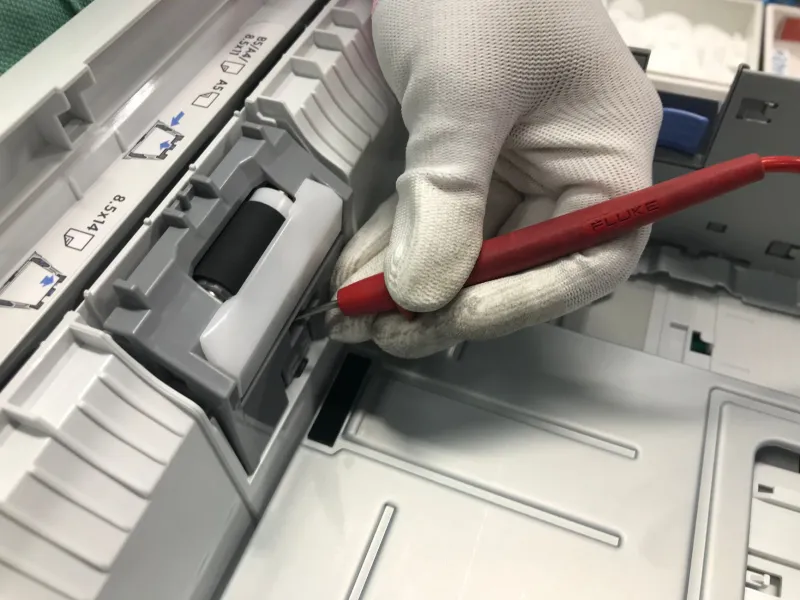
Pickup rollers are the first point of contact between the machine and the paper. They grip each sheet and draw it into the feed path. Over time, the rubber compound degrades, hardens, and loses the friction coefficient it needs to function reliably. Separation pads work in tandem, ensuring only one sheet advances at a time. When they wear down, multi-feeds and misfeeds become routine. Feed rollers then guide the sheet through the internal paper path — and when their surface deteriorates, the paper skews, jams, or fails to advance entirely.
In a high-volume office environment, these components typically have a rated lifespan measured in tens of thousands of pages. Once that threshold is crossed, failure is not a possibility — it is a schedule.
A Service Case That Illustrates the Full Cost
One of our more instructive remote support cases involved a mid-sized legal firm in the United States that contacted Printer Service Jalandhar after experiencing what their IT coordinator described as "constant paper jams across multiple trays" on their primary document production printer. The device — a commercial-grade laser printer purchased at significant capital expense — had been in continuous operation for approximately four years without a single scheduled maintenance visit.
When our diagnostic team walked through the service history remotely, the pattern was immediately clear. The pickup rollers had not been replaced since installation. The separation pad was original equipment. The feed kit, which carries a manufacturer-recommended replacement interval, had been deferred through multiple IT budget cycles because it was categorized as a non-urgent line item.
The actual component cost for a complete feed kit replacement on that machine: under $40.
The cost incurred by the time the firm reached out to us included emergency service fees, a full day of paralegal productivity lost to manual workarounds, a missed court filing deadline that required expedited courier services, and a secondary diagnosis of paper path damage caused by repeated forced-jam clearances by staff who had no formal training in printer mechanics. The total conservative estimate of that single deferred maintenance decision exceeded $2,800.
This is not an unusual case. It is, in our experience, a representative one.
Why US Businesses Consistently Defer These Replacements
The behavioral pattern behind deferred component maintenance is well-documented in operational psychology. When a system continues to function — even intermittently and imperfectly — decision-makers tend to delay intervention until the failure is complete. In printer maintenance, this translates to tolerating two or three paper jams per day as "normal" until the machine produces nothing at all.
There are structural reasons this happens in American business environments specifically. First, printer maintenance is rarely assigned to a dedicated owner. In small to mid-sized businesses, it falls somewhere between facilities management and IT, and neither department claims it with enthusiasm. Second, the cost of the component itself — often under $50 — creates a cognitive mismatch. It seems too small to warrant a formal service ticket, yet no one replaces it informally either. Third, many US offices operate on reactive maintenance models, meaning service is only requested after failure, not before it.
The result is a system where the least expensive intervention — scheduled wear-part replacement — is perpetually postponed in favor of addressing more visible, higher-cost failures that could have been prevented entirely.
The ROI Calculation Most Offices Skip
Preventive component replacement is straightforward to justify on paper, yet it remains underutilized in practice. Consider the math from a purely operational standpoint.
A typical enterprise printer feed kit, including pickup rollers, separation pad, and feed rollers, costs between $30 and $80 depending on the make and model. Professional installation through a remote-guided service session adds a modest labor cost. The entire intervention, completed proactively on a scheduled cycle, rarely exceeds $150 when parts and guided support are combined.
Contrast that against even a conservative estimate of downtime costs. If a printer serves ten employees who each earn $25 per hour, and a jam-related outage disrupts workflow for two hours across the team, that is $500 in lost productive labor — before accounting for any deadline consequences, client-facing delays, or emergency service premiums.
The return on a $150 preventive maintenance investment, measured against a single avoided two-hour outage, is positive on the first occurrence. Across a twelve-month operating cycle, the ROI compounds significantly.
Building a Component Replacement Schedule That Actually Works
The most effective approach to avoiding feed-kit failures is treating these components exactly as you would treat consumables like toner — as predictable, scheduled replacements rather than reactive repairs.
Most enterprise printer manufacturers publish recommended replacement intervals for wear items in the device's service documentation. These intervals are typically expressed in page counts and can be tracked through the printer's internal counter, accessible through its administrative panel or network management interface. Setting a calendar reminder when a device approaches 80 percent of a component's rated lifespan gives operations teams adequate lead time to order parts and schedule a service window without disruption.
For businesses managing multiple devices — a common situation in distributed US office environments — a centralized maintenance log that tracks each printer's component replacement history is an inexpensive but highly effective operational tool. Our team at Printer Service Jalandhar routinely assists US clients in establishing these logs as part of our remote support engagements, and the reduction in emergency service requests is consistently measurable within the first quarter of implementation.
The Larger Principle Behind the Paradox
The Paper Jam Paradox is ultimately a story about proportion — specifically, the disproportionate consequences that flow from neglecting small, inexpensive, easily replaceable items. It is a principle that applies across mechanical systems, but printers illustrate it with particular clarity because the failure is so immediate, so visible, and so disruptive to daily operations.
No business would allow a $50,000 vehicle to run without scheduled oil changes because the oil costs $40. The same logic applies to the high-output printers that process thousands of documents per month and underpin critical business workflows. The components that keep those machines running reliably are not glamorous, and they are not expensive. But ignoring them is.
Scheduled wear-part replacement is not a cost — it is a hedge against a far larger one. For US businesses still operating on reactive maintenance models, that distinction is worth understanding before the next jam brings everything to a stop.