When One Worn Roller Shuts Down an Entire Office: The True Cascade Cost of Deferred Printer Maintenance
The Jam That Nobody Took Seriously
It started, as it often does, with a familiar sound: the mechanical stutter of a printer struggling to pull paper through its feed assembly. A quick tug, a muttered complaint, and the office moved on. The printer resumed working — for a while.
Three weeks later, that same machine was offline entirely. Two client deadlines had been missed. An IT contractor had billed four hours of emergency labor. Replacement parts were on back-order. And somewhere buried in an email thread, a technician had flagged the roller wear six months earlier.
This scenario plays out with troubling regularity in small and mid-sized US offices. According to service data compiled by printer repair professionals, a significant proportion of catastrophic printer failures trace back to a single unaddressed mechanical issue — one that was, at some earlier point, both detectable and inexpensive to resolve. The cascade begins not with negligence, but with a very human tendency to prioritize immediate productivity over preventive care.
The Anatomy of a Mechanical Domino Effect
Printer failures rarely arrive without warning. The machinery involved in moving paper from tray to output bin is interdependent in ways that are easy to underestimate. When one component begins to degrade, it places compensatory stress on adjacent components — a relationship that can remain invisible until the system reaches a tipping point.
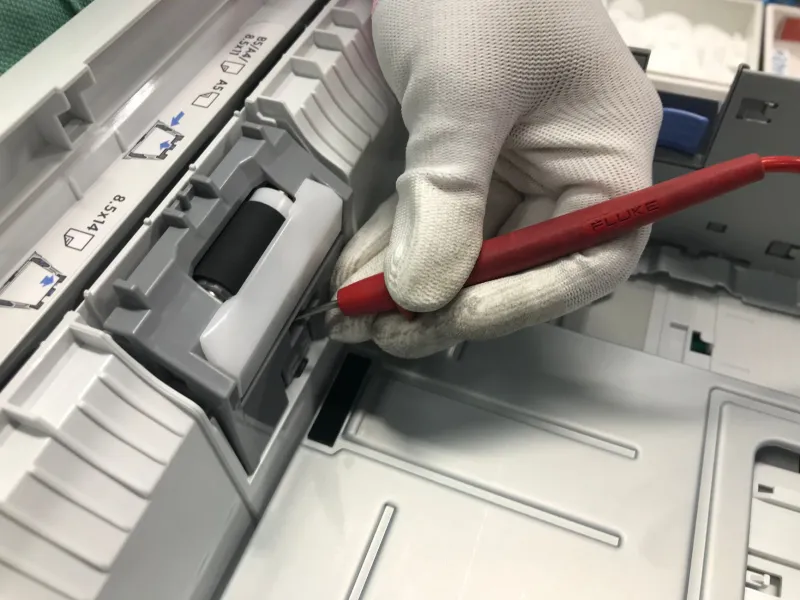
Consider the feed roller. Over time, the rubber surface of a feed roller hardens and loses the friction coefficient necessary to grip paper cleanly. The printer begins to misfeed — pulling sheets at a slight angle, or failing to separate individual pages. These are the early symptoms. A user who clears the jam and moves on has addressed the symptom, not the cause.
As the roller continues to degrade, the frequency of jams increases. Each jam event places mechanical stress on the paper path guides, which are not designed to absorb repeated lateral paper movement. The guides begin to flex slightly out of alignment. Now, even paper that feeds correctly encounters resistance partway through the path, creating secondary jams deeper inside the machine — jams that are considerably more difficult to clear without damaging internal components.
At this stage, the fuser unit — which applies heat and pressure to bond toner to the page — begins to receive paper that is inconsistently aligned. The fuser rollers, operating under precise tolerances, are not designed to accommodate misaligned media. Premature fuser wear accelerates. In laser printers, a fuser replacement typically runs between $150 and $400 in parts alone, before labor.
Meanwhile, users attempting to clear deep jams are reaching into areas of the machine they are not trained to access. Delicate transfer belts, sensor flags, and corona wires are disturbed. A sensor flag bent by an uninformed hand can cause the printer to report persistent error codes even after the physical jam is resolved, triggering further diagnostic labor.
The Hidden Costs That Never Appear on the Repair Invoice
Service professionals frequently observe that the invoice for a printer repair represents only a fraction of the actual cost absorbed by a business. The remaining costs are distributed across the organization in ways that never consolidate into a single line item — which is precisely why they remain invisible to management.
Consider a mid-sized accounting firm in the Midwest that experienced a cascading printer failure during tax season. The direct repair cost was approximately $620. However, the full accounting of downstream damage told a different story:
- Staff productivity loss: Four employees spent a combined nine hours managing workarounds, redistributing print jobs to a secondary device, and manually collating documents that would otherwise have been printed in sequence. At an average billable rate, this represented over $1,800 in lost productive time.
- Emergency IT labor: An outside contractor was engaged for same-day diagnostic work, billed at a premium rate. Total: $380.
- Client relationship damage: One client experienced a delay in receiving a finalized document package. While no formal complaint was filed, the relationship required additional communication hours to manage. Estimated value of at-risk contract: $8,500.
- Expedited supply order: Replacement toner and maintenance kit components were ordered via overnight shipping due to the urgency of the situation. Premium over standard shipping: $74.
Total estimated impact: approximately $11,374. The original roller replacement, had it been performed at the first sign of wear, would have cost less than $85 in parts and under an hour of service labor.
The Psychology of the Quick Fix
Understanding why deferred maintenance persists requires acknowledging the psychological dynamics at play in a busy office environment. When a printer jams, the immediate goal is to restore function as quickly as possible. Clearing the jam achieves that goal. The printer works. The crisis — as perceived in the moment — is resolved.
This creates a powerful reinforcement cycle. Each successful quick fix confirms the belief that the problem is manageable without formal intervention. The cost of inaction remains theoretical; the cost of scheduling a technician visit is immediate and concrete. For office managers already managing constrained budgets and competing priorities, the calculation consistently favors deferral.
Service professionals refer to this pattern as "maintenance debt" — an accumulation of small, unaddressed issues that compound over time in the same way that financial debt compounds with interest. The longer the deferral, the higher the eventual cost. Unlike financial debt, however, maintenance debt tends to resolve suddenly and catastrophically rather than gradually.
There is also a communication gap that contributes to the problem. The employee who first notices a recurring jam is rarely the person with authority to schedule a maintenance visit. By the time the information travels through the appropriate channels, the urgency has often dissipated — until the next jam, which is invariably worse.
Establishing a Maintenance Framework That Breaks the Cycle
The solution is neither complex nor expensive in its early stages. What it requires is a structured approach to printer health monitoring that treats warning signs as actionable data rather than minor inconveniences.
Effective maintenance frameworks typically include the following elements:
Scheduled inspections at defined intervals. Rather than waiting for a failure event, businesses benefit from establishing regular inspection cycles tied to page volume milestones. A printer producing 2,000 pages per month should be professionally inspected at least twice annually, with roller and pad replacement performed proactively.
A documented jam log. Requiring staff to record jam events — including frequency, location within the paper path, and any associated error codes — transforms anecdotal complaints into actionable data. A pattern of jams at the same location, occurring more than twice in a two-week period, should trigger a service call regardless of whether the machine appears to be functioning normally.
Clear escalation protocols. Employees should understand precisely when a jam requires professional attention rather than a self-service fix. As a general guideline, any jam requiring access beyond the standard paper tray and rear access panels should be escalated to a qualified technician.
Vendor relationships established before emergencies occur. Businesses that have an established relationship with a reliable printer service provider — one familiar with their specific equipment — consistently experience shorter repair turnaround times and lower emergency labor premiums than those who contact a service provider for the first time in the middle of a crisis.
The Maintenance Investment in Perspective
The arithmetic of preventive printer maintenance is not complicated. A comprehensive annual maintenance agreement for a small office printer fleet typically costs a fraction of a single emergency repair event — and a fraction of a fraction of the downstream productivity and relationship costs that accompany a catastrophic failure.
The challenge is not financial. It is organizational: building the discipline to treat a smoothly functioning printer as evidence that the maintenance system is working, rather than evidence that maintenance is unnecessary.
For US businesses operating in competitive environments where workflow continuity is a genuine operational asset, the cost of that discipline is one of the more straightforward investments available. The cost of neglecting it, as the evidence consistently demonstrates, is substantially higher than it ever needed to be.