Three Cartridges, Three Very Different Bills: Running the Real Numbers on Refill, Reman, and OEM Toner
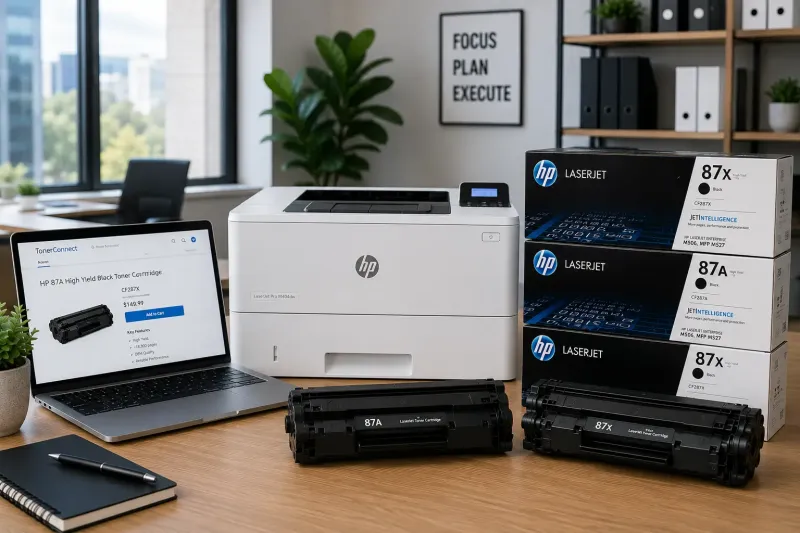
Photo: toner cartridges comparison desk small business office, via blog-new.tonerconnect.net
Ask ten small business owners how they buy toner and you will get three camps: the loyalists who pay OEM prices without complaint, the pragmatists who order remanufactured cartridges in bulk, and the bargain hunters who refill everything in-house. What you will rarely hear is anyone quoting actual numbers — because almost nobody has run them.
Let's do that now, for a hypothetical but entirely typical ten-person office printing 3,000 pages per month on a common monochrome laser model.
Setting the Baseline: What a Page Actually Costs
A standard OEM black toner cartridge for a popular office laser printer might run $85 and yield roughly 3,000 pages at 5% coverage. That works out to about 2.8 cents per page. A high-yield OEM cartridge at $130 for 6,000 pages drops the figure to roughly 2.2 cents.
Now the alternatives. A remanufactured high-yield cartridge — an original shell that has been emptied, cleaned, refilled, and tested — typically prices at 30 to 40% below OEM, landing around $80 for comparable yield, or about 1.3 cents per page. A DIY refill kit, where toner is injected into the existing cartridge, might cost $25 and stretch to 4,000 pages if all goes well: roughly 0.6 cents per page.
For our 3,000-page office, the annual spread is meaningful: roughly $792 per year at OEM high-yield pricing, $468 with remanufactured, and $180 with refills — a difference of over $600 annually on black-and-white alone. Color printing widens that gap considerably, since it multiplies the consumables by four.
What the Savings Buy — and What They Risk
The honest answer is that quality tiers exist for reasons. Remanufactured cartridges from reputable North American remanufacturers undergo component replacement — drums, wiper blades, and rollers are swapped, not just refilled — and consistently test within a small margin of OEM output for everyday business documents. Budget offshore imports, by contrast, are a different product category entirely, and quality control is inconsistent at best.
DIY refills carry the steepest hidden costs. The cartridge shell wears with each cycle; a refilled cartridge on its third or fourth cycle is running on degraded internal components, which is why refill users report higher rates of leaks, streaking, and page yield shortfalls. A toner leak that damages a drum unit converts a $25 saving into a $150 repair in a single afternoon.
The Warranty Question, Answered Plainly
Here is the clarification most offices need: under the Magnuson-Moss Warranty Improvement Act, a printer manufacturer cannot void your warranty simply for using third-party consumables. What they can do is decline to cover damage directly caused by a defective third-party cartridge — and they will document that carefully when it happens. In practice, this means third-party supplies are legally protected, but the risk of a disputed damage claim shifts to you.
A Decision Framework Rather Than a Verdict
For internal documents, drafts, and high-volume text printing, quality remanufactured cartridges from an established supplier offer the best balance of cost and reliability — and for most ten-person offices, they are the rational default. Reserve OEM cartridges for client-facing materials, color-critical work, and any device still under a service contract that specifies them. Treat DIY refills as a niche option for low-stakes volume only, and never on a printer whose drum and fuser you cannot afford to replace.
The worst strategy is the unexamined one — auto-reordering the same cartridge year after year without ever running this math. Six hundred dollars a year, redirected from consumables to something that grows the business, is a decision worth making deliberately.