When In-House Tinkering Backfires: The True Financial Toll of DIY Printer Repairs
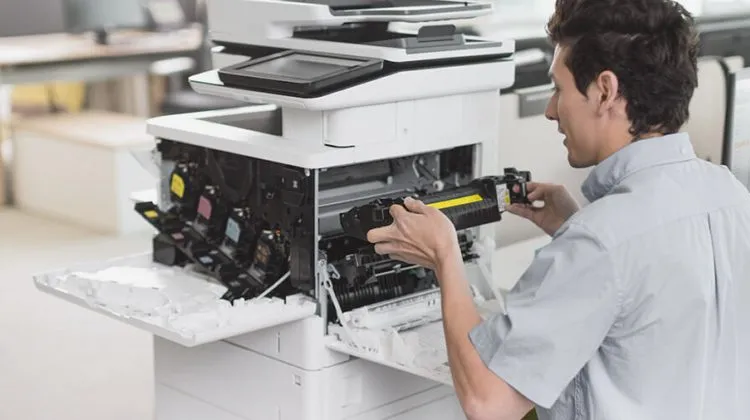
Photo: frustrated IT professional repairing office printer with tools and parts scattered on desk, via techdogsonline.com
For most American small and mid-sized businesses, the office printer exists somewhere between a utility and a nuisance. When it jams, streaks, or refuses to connect, the instinctive response is to dispatch an IT generalist — someone who is technically capable but rarely specialized in printer hardware. That instinct, while understandable, is quietly generating significant financial losses across industries.
At Printer Service Jalandhar, we work with organizations across the globe, including US-based clients who have come to us after exhausting their internal resources. The patterns we observe are strikingly consistent: what begins as a routine fix escalates into a costly repair cycle, and what could have been a $90 service call transforms into a $1,200 replacement purchase.
The Illusion of Savings
On the surface, using your existing IT team to address printer problems seems economical. There are no service call fees, no scheduling delays, and no dependency on external vendors. However, this logic breaks down quickly when you account for the full cost picture.
Consider the hourly rate of a mid-level IT professional in the United States — typically between $35 and $75 per hour depending on location and experience. A printer issue that a specialized technician could resolve in 45 minutes may consume three to four hours of an IT generalist's time, simply because printers are not their domain. During that window, the employee troubleshooting the printer is unavailable for higher-priority tasks, compounding the productivity loss.
Now factor in the risk of misdiagnosis. Printer hardware — particularly laser printers and multifunction devices — involves fuser assemblies, drum units, transfer belts, and firmware systems that behave very differently from standard computer hardware. An IT professional who is accustomed to network configurations and software deployments may misidentify a fuser problem as a paper feed issue, apply an incorrect fix, and inadvertently cause secondary damage to components that were previously functioning correctly.
Case Study: A Chicago-Based Logistics Firm
One mid-sized logistics company in the Chicago area faced a recurring paper jam issue with their fleet of six HP LaserJet printers. Their IT coordinator attempted to resolve the problem by replacing the paper tray assemblies — a reasonable hypothesis, but ultimately the wrong diagnosis. The actual culprit was a worn separation pad on the main feed roller, a component that costs approximately $12.
By the time the correct issue was identified — after three rounds of incorrect part replacements and two weeks of intermittent printer downtime — the company had spent over $800 in parts and labor. Two of the six printers had sustained additional wear due to repeated disassembly by personnel unfamiliar with the correct reassembly torque specifications. One unit was ultimately written off as non-repairable.
When the company transitioned to a managed printer maintenance arrangement with a specialized remote provider, their average resolution time dropped from 2.3 days to under four hours, and their annual printer-related expenditure fell by approximately 47%.
Warranty Voidance: The Silent Budget Killer
Another dimension of DIY printer repair that rarely receives adequate attention is warranty invalidation. Most commercial printer manufacturers — including HP, Canon, Epson, and Brother — include explicit clauses in their warranty agreements that void coverage if unauthorized personnel perform internal repairs or if non-certified parts are installed.
For businesses operating under tight margins, losing warranty protection on a $600 to $2,000 printer because an IT employee opened the chassis without proper certification can be a significant financial blow. Specialized service providers, by contrast, operate within manufacturer-approved frameworks and can often perform repairs that preserve or restore warranty eligibility.
The Downtime Multiplier
Downtime is perhaps the most underestimated component of printer repair costs. In environments where printing is integral to daily operations — legal firms, healthcare offices, real estate agencies, accounting practices — every hour a printer is offline translates directly into delayed deliverables, frustrated staff, and in some cases, missed compliance deadlines.
Research from industry analysts consistently shows that printer downtime costs US businesses an average of $700 to $1,500 per incident when all associated productivity losses are factored in. Multiply that across a year of recurring issues caused by incomplete or incorrect in-house repairs, and the figure becomes substantial.
Why Specialized Outsourcing Changes the Equation
The case for outsourcing printer maintenance to specialized providers is not purely about cost reduction — though the savings are real and measurable. It is fundamentally about operational reliability and risk management.
Specialized printer technicians bring model-specific expertise, access to genuine OEM parts, and diagnostic tools that general IT staff simply do not possess. Remote support providers, including those based in Jalandhar with established US client relationships, can often diagnose and guide resolution of hardware issues within a single support session, eliminating the trial-and-error cycles that define most in-house troubleshooting efforts.
For businesses that have made the transition, the reported reduction in total cost of ownership typically ranges from 40% to 60% over a 12-month period. These savings emerge not from paying less per service call, but from requiring fewer service calls overall, avoiding unnecessary hardware replacements, and reclaiming IT bandwidth for higher-value activities.
Rethinking the Role of Your IT Team
This is not an argument against the competence of in-house IT professionals. Rather, it is a case for strategic specialization. Just as a general practitioner refers complex cases to a cardiologist, a strong IT team should recognize when printer hardware exceeds their efficient resolution capacity and engage specialized support accordingly.
Building a relationship with a reliable printer service provider — one that understands your equipment fleet, your usage patterns, and your operational priorities — transforms printer maintenance from a reactive headache into a managed, predictable line item. That shift in posture is where the real strategic value lies.
At Printer Service Jalandhar, we have helped organizations across multiple industries reach exactly that point of stability. The investment in specialized expertise consistently returns more than it costs — and the businesses that recognize this earliest tend to be the ones that scale most effectively.