Beyond the Supply Chain Crisis: How Round-the-Clock Indian Printer Support Is Becoming a US Business Necessity
The phrase "supply chain disruption" has become so commonplace in American business discourse that it risks losing its urgency. Yet for operations managers and IT directors responsible for keeping office infrastructure running, the disruptions are anything but abstract. Toner cartridges that once arrived in two days now take two weeks. Certified printer technicians in major US metro areas are booked weeks out. And the equipment sitting idle in the meantime is not simply an inconvenience — it is a measurable drag on productivity, revenue, and employee morale.
Against this backdrop, a growing number of US businesses are making a strategic pivot: establishing formal partnerships with specialized printer service providers in India. This is not a novel concept, but its urgency has intensified considerably. What was once a cost-optimization strategy has matured into something closer to an operational necessity.
The Technician Shortage Nobody Is Talking About
The United States is experiencing a well-documented shortage of skilled tradespeople, and printer and imaging equipment technicians are no exception. According to workforce trend data, the number of trained printer service professionals has declined steadily over the past decade as the profession struggles to attract younger entrants and as experienced technicians retire without adequate replacement pipelines.
The consequences are felt most acutely by small and mid-sized businesses that lack the purchasing power to lock in priority service agreements with major vendors. For these organizations, a malfunctioning multifunction printer can mean days of waiting for a service appointment — days during which documents go unprinted, workflows stall, and workarounds multiply.
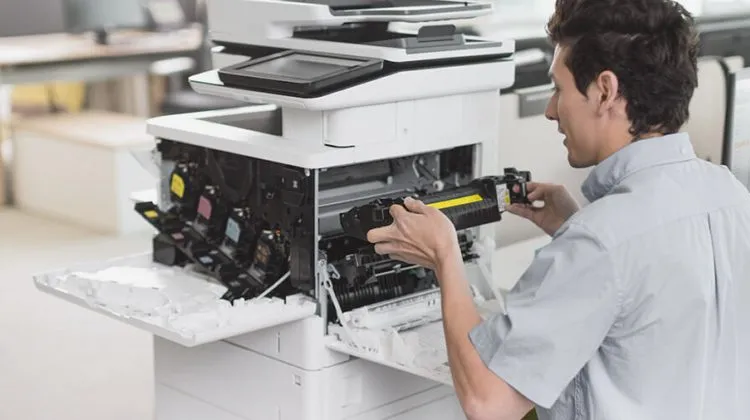
Remote support from specialized providers addresses a meaningful portion of this gap. While not every printer problem can be resolved without physical intervention, a significant share of common issues — firmware errors, driver conflicts, connectivity failures, print quality degradation, and paper feed irregularities — can be diagnosed and corrected through guided remote sessions. For US businesses with competent but non-specialized staff on-site, a remote expert can serve as the guiding intelligence that transforms an unresolved problem into a completed repair.
The Time-Zone Advantage: A Strategic Asset
One of the most compelling and frequently underappreciated arguments for partnering with Indian service providers is the natural time-zone alignment that enables genuine 24/7 support coverage.
When a law firm in Atlanta encounters a printer failure at 11:00 PM before a critical morning filing, their US-based service provider is almost certainly unavailable. An Indian partner operating during standard business hours in Jalandhar — which corresponds to late evening and early morning US Eastern Time — can respond immediately, guide on-site staff through diagnostic steps, and in many cases achieve full resolution before the American business day begins.
This is not theoretical. It is a structural advantage that forward-thinking businesses are beginning to treat as a genuine component of their business continuity planning, rather than a secondary benefit of outsourcing.
Cultural Competency and Communication Quality
A common hesitation among US businesses considering overseas technical partnerships is the concern about communication barriers — whether language, technical vocabulary, or cultural context might impede effective support interactions. These concerns, while understandable, are increasingly outdated when applied to established Indian IT and technical service providers.
India's technology services sector has spent decades refining its capacity for clear, professional communication with American clients. Providers like Printer Service Jalandhar operate with English as a primary business language, employ technicians trained on the same equipment brands that dominate the US market, and maintain familiarity with the operational contexts — healthcare, legal, finance, retail — in which their clients operate.
The result is a support interaction that feels less like a cross-border transaction and more like engaging a knowledgeable colleague who happens to be in a different time zone.
How to Vet an Indian Printer Service Partner
For US businesses ready to explore this model, due diligence is essential. Not all overseas providers offer the same depth of expertise, responsiveness, or reliability. The following framework can help organizations identify partners worth trusting.
Verify technical certifications. Reputable providers should be able to demonstrate familiarity with major printer manufacturers — HP, Canon, Epson, Xerox, Brother, Ricoh — and ideally hold or reference manufacturer-adjacent training credentials.
Assess communication infrastructure. A reliable partner should offer multiple contact channels, including phone, email, and live chat, with clearly defined response time commitments. Test their responsiveness before signing any agreement.
Request client references. Ask specifically for references from US-based clients in industries similar to your own. Peer validation from comparable organizations is among the most reliable indicators of service quality.
Review escalation protocols. Understand how the provider handles issues that cannot be resolved remotely. Do they have established relationships with on-site partners in the US? Can they coordinate parts sourcing and local technician dispatch when necessary?
Evaluate data and security practices. Any remote support engagement involves some degree of access to your network environment. Confirm that your prospective partner adheres to data handling practices consistent with US regulatory expectations, including HIPAA considerations for healthcare clients.
Building the Partnership, Not Just the Contract
The businesses that extract the greatest value from overseas printer support partnerships are those that approach the relationship as a long-term operational alliance rather than a transactional vendor arrangement. This means investing time in onboarding your provider with documentation of your equipment fleet, usage patterns, and operational priorities.
A provider who understands that your accounting firm prints high-volume reports every quarter-end, or that your real estate office depends on color printing for client presentations, will calibrate their support priorities accordingly. That contextual awareness — built over time through a genuine partnership — is what separates adequate support from genuinely excellent support.
A Strategic Posture for Uncertain Times
The supply chain volatility and technician shortages that have defined recent years show no signs of resolving quickly. For US businesses, the prudent response is not to wait for conditions to normalize, but to build support structures that are resilient regardless of domestic market constraints.
Partnering with specialized Indian printer service providers represents exactly that kind of structural resilience. It extends your support coverage, reduces your dependency on a strained domestic technician market, and — when the partnership is well-constructed — delivers a level of responsiveness and expertise that many US providers currently struggle to match.
At Printer Service Jalandhar, we have built our practice around exactly this model: deep technical specialization, genuine availability across US business hours, and a commitment to treating every client's printer infrastructure as the business-critical asset it truly is. The businesses that recognize the strategic value of this kind of partnership today will be the ones best positioned to operate without interruption tomorrow.