How a Structured Maintenance Calendar Eliminates Late-Night Printer Emergencies
The 2 AM Printer Crisis Is Almost Always Avoidable
There is a particular kind of dread familiar to office managers across the United States: the late-night phone call informing them that the printer has jammed, failed, or stopped communicating entirely — and a critical deadline is six hours away. What makes this scenario especially frustrating is that, in the vast majority of cases, the failure did not appear without precedent. The machine had been sending signals for weeks. They simply went unacknowledged.
Preventive printer maintenance is not a novel concept, but it remains surprisingly underutilized among small and mid-sized US businesses. According to industry service data, reactive repair calls — those initiated only after a device has already failed — cost between two and four times more than equivalent work performed during a scheduled maintenance visit. The difference is not merely the cost of parts; it is the premium charged for urgency, the productivity lost during unplanned downtime, and the compounding effect of deferred problems that have grown worse over time.
This article outlines a practical maintenance schedule that any US office can implement, describes the specific failure patterns that precede major breakdowns, and explains how remote coordination with an experienced provider such as Printer Service Jalandhar can make proactive upkeep both affordable and logistically straightforward.
Understanding How Printers Actually Degrade
Before establishing a maintenance calendar, it is worth understanding how printer components wear over time. Most office-grade printers — whether laser or inkjet — share a common degradation pattern that follows predictable stages.
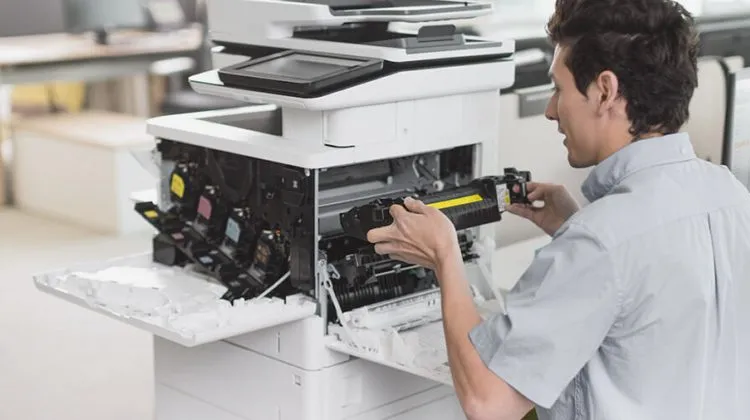
Fuser assembly wear is among the most common precursors to serious failure in laser printers. The fuser applies heat and pressure to bond toner to paper, and its rollers accumulate debris and lose elasticity over tens of thousands of print cycles. Early symptoms include faint smearing on printed pages, inconsistent toner adhesion, and a faint burning odor during operation. Left unaddressed, fuser degradation leads to paper jams, partial prints, and eventually complete unit failure.
Pickup and feed rollers deteriorate through friction. As rubber components age, they lose the grip necessary to draw paper cleanly through the feed path. The first indication is typically intermittent misfeeds — paper that skews slightly or requires a second attempt to load. Businesses frequently dismiss these incidents as paper quality issues, delaying roller inspection until multi-sheet jams become routine.
Drum units and imaging components in laser printers have finite page yields specified by manufacturers. Operating beyond those thresholds does not always produce immediate failure, but print quality degrades progressively: lines appear on output, background shading becomes uneven, and toner consumption increases. These are not cosmetic inconveniences — they are diagnostic indicators that the imaging cycle is compromised.
Ink delivery systems in inkjet devices face a different class of problem. Printhead clogging, caused by dried ink in dormant nozzles, is the leading cause of inkjet failure in office environments where devices sit unused for extended periods. Regular low-volume print cycles — even a single test page per week — can prevent the kind of nozzle blockage that requires professional cleaning or printhead replacement.
A Practical Maintenance Interval Framework
The following schedule reflects industry best practices adapted for typical US office environments. Actual intervals should be adjusted based on print volume, device age, and manufacturer specifications.
Weekly tasks (user-level):
- Run a printer self-test or configuration page to verify output quality
- Inspect the paper tray for debris, torn fragments, or moisture
- Confirm firmware is current if automatic updates are not enabled
- For inkjet devices, run a nozzle check pattern and cleaning cycle if output quality has declined
Monthly tasks (designated staff or remote-guided):
- Clean exterior vents and paper path access points with compressed air or approved lint-free cloths
- Inspect visible rollers for surface cracking, glazing, or debris accumulation
- Review error log history through the device's administrative interface
- Verify network connectivity stability and print queue health
- Check toner or ink levels and order replacements before supplies fall below 20 percent capacity
Quarterly tasks (professional or remote-assisted):
- Full internal cleaning of paper path components
- Roller inspection and lubrication or replacement as warranted
- Fuser assembly evaluation based on page count relative to rated lifespan
- Calibration verification for color accuracy on devices used in client-facing output
- Review of print volume trends to anticipate component end-of-life
Annual tasks (comprehensive service):
- Full mechanical inspection of all moving components
- Preventive replacement of high-wear parts approaching manufacturer-rated end-of-life
- Firmware audit and update
- Network and driver configuration review
- Documentation of device service history for warranty and lifecycle planning purposes
How Remote Coordination Makes This Feasible
One of the most common objections US businesses raise regarding preventive maintenance is the perceived logistical burden. Scheduling technician visits, coordinating around office hours, and managing the administrative overhead of a maintenance program can feel like more work than simply calling for repairs when something breaks.
This is precisely where a coordinated offshore support relationship changes the calculus. Printer Service Jalandhar provides remote diagnostic and advisory services that allow US businesses to conduct guided inspections without requiring an on-site technician for every maintenance interval. Through scheduled video consultations, remote access to device administrative interfaces, and structured reporting protocols, a qualified technician can evaluate device health, identify emerging issues, and direct in-house staff through corrective procedures — all outside of US business hours, which aligns naturally with the time zone difference between India and North America.
The financial implication is significant. A comprehensive annual remote support agreement with Printer Service Jalandhar typically costs a fraction of a single emergency repair call, particularly when that emergency involves expedited parts procurement, after-hours labor rates, and the downstream cost of missed deadlines.
The Cost Comparison That Should Change Your Approach
Consider a realistic scenario: a mid-sized US office operating two laser printers at moderate volume. Without a maintenance program, each device might require one major repair per year — a fuser replacement, a roller kit, or a drum unit swap performed reactively after failure. At standard US service rates, each reactive repair visit can range from $150 to $400, excluding parts, with emergency or after-hours premiums adding 25 to 50 percent to that figure.
A preventive maintenance program that addresses those same components proactively — during scheduled intervals, before failure occurs — typically reduces per-incident cost by 40 to 60 percent. More importantly, it eliminates the unplanned downtime that carries its own cost in lost productivity, rescheduled work, and the intangible but very real stress of a 2 AM equipment crisis.
Prevention Is a Management Decision, Not a Technical One
The most important insight about printer maintenance is that it is not primarily a technical challenge — it is an operational one. The knowledge required to implement an effective schedule is accessible. The service resources exist. The cost savings are well-documented. What separates businesses that experience chronic printer emergencies from those that do not is, in most cases, a deliberate decision to treat maintenance as a scheduled business function rather than an afterthought.
Establishing that discipline — supported by a reliable service partner like Printer Service Jalandhar — is one of the more straightforward operational improvements a US small business can make. The 2 AM phone call is not inevitable. It is, in nearly every case, the consequence of a decision that was made weeks or months earlier.