Small Fixes, Compounding Failures: The Real Financial Cost of Temporary Printer Workarounds
The Workaround That Costs More Than the Repair
Every office manager in America has been there. The printer jams mid-morning, a deadline looms, and someone on the team discovers that holding down a specific button while manually feeding paper resolves the immediate crisis. Work resumes. The problem is noted, filed away mentally, and quietly forgotten until it happens again — usually at a worse moment, with worse consequences.
This pattern is so common it has become embedded in office culture as practical problem-solving. In reality, it is one of the most financially damaging habits a small business can develop around its printing infrastructure. What feels like resourcefulness is, in engineering terms, the systematic concealment of a deteriorating component — one that will eventually fail in a manner far more disruptive and expensive than the original symptom ever suggested.
Understanding why requires a closer look at how printers actually fail, and how human behavior around those failures tends to accelerate the damage.
How Printers Signal Distress — And Why We Ignore It
Modern office printers are precisely calibrated machines. When a roller wears unevenly, when a fuser assembly begins losing thermal consistency, or when a feed mechanism develops even minor mechanical resistance, the device communicates these conditions through symptoms: misfeeds, streaking, slow processing, or error codes that disappear after a restart.
These symptoms are diagnostic signals. They indicate that a specific component has crossed a performance threshold and requires attention. Ignoring them — or worse, developing workarounds that suppress the visible symptom without addressing its cause — does not resolve the underlying condition. It simply removes the feedback mechanism that would otherwise prompt corrective action.
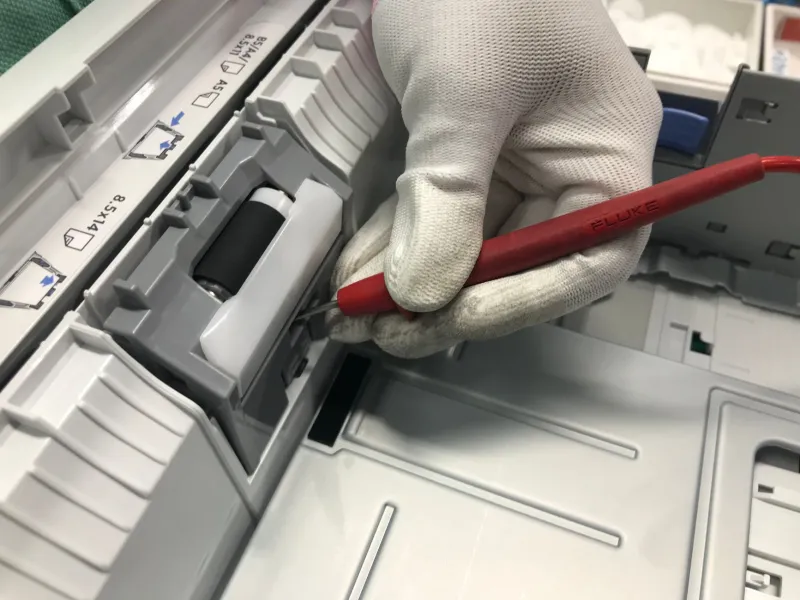
Consider a common scenario: a pickup roller that has begun slipping due to surface wear. The early symptom is an occasional misfeed, perhaps once every forty or fifty sheets. A staff member learns to reinsert the paper manually when this occurs. The workaround works. But the roller continues to degrade. Within weeks, the misfeed frequency increases. The manual intervention becomes routine. The roller, now significantly worn, begins placing lateral stress on the paper path guides. Those guides, never designed to absorb that kind of repeated mechanical pressure, begin to warp.
By the time the printer fails completely — refusing to feed paper at all — the repair no longer involves replacing a single roller. It involves a roller assembly, guide realignment, and potentially a paper path sensor that was damaged by repeated misfeed pressure. A repair that might have cost $80 to $120 at first symptom has become a $300 to $500 service call, assuming the unit is still worth repairing at all.
The Compounding Mathematics of Deferred Diagnosis
The financial logic of workarounds is seductive because the immediate cost appears to be zero. No technician is called. No service invoice is generated. The printer continues functioning, however imperfectly, and the business moves forward.
But deferred diagnosis carries its own accounting. Each day a degrading component operates under stress accelerates wear on adjacent parts. Mechanical failures rarely remain isolated — they propagate. A failing fuser, for example, does not simply produce poor print quality. Operating at incorrect temperatures, it stresses the drum unit, which in turn affects toner transfer efficiency, which accelerates toner consumption. A business applying workarounds to fuser symptoms may find itself purchasing replacement toner cartridges at twice the normal rate without ever connecting the increased consumption to the original malfunction.
This is the compounding effect that makes temporary fixes genuinely dangerous from a financial standpoint. The costs do not remain static while the workaround holds. They accumulate invisibly, distributed across supply purchases, productivity losses, and eventually a repair bill that reflects months of cascading damage rather than a single component failure.
For small businesses operating on tight margins — a reality for most independent US operations — this compounding effect can be the difference between a manageable maintenance expense and an unbudgeted capital outlay that disrupts quarterly planning.
Why Amateur Diagnosis Frequently Misidentifies the Problem
There is a second layer to this issue that goes beyond deferred action: the problem of misidentified root causes. When a non-technical staff member or a generalist IT contact attempts to diagnose a printer malfunction, they are working from observable symptoms rather than component-level understanding. This frequently leads to interventions that address the wrong element entirely.
A printer producing faded output, for instance, might prompt an immediate toner cartridge replacement — a logical response, and one that a supplier is happy to facilitate. But faded output can also result from a worn doctor blade, a failing high-voltage power supply board, or a drum unit that has exceeded its service life. Replacing the toner cartridge in these scenarios produces no improvement, wastes the cost of a new cartridge, and leaves the actual cause of degradation untreated.
Repeated misdiagnosis creates a pattern of expenditure that looks, on paper, like normal supply consumption. It is only when the underlying component fails catastrophically that the true cost becomes visible — by which point the damage is significantly more extensive than it would have been with accurate early diagnosis.
The Case for Professional Assessment at First Symptom
The financial argument for engaging a qualified printer technician at the first sign of malfunction is straightforward, even if it feels counterintuitive in the moment. A professional diagnostic assessment identifies the precise component or system responsible for the symptom. It establishes whether the failure is isolated or indicative of broader wear. It produces a repair estimate grounded in actual component costs rather than guesswork. And it prevents the weeks of compounding degradation that follow a missed or misidentified diagnosis.
For US businesses accustomed to viewing printer maintenance as an incidental expense, reframing it as a form of operational risk management changes the calculus considerably. The question is not whether professional service costs money. It does. The question is whether that cost is less than the alternative — and in the overwhelming majority of documented cases, early professional intervention is substantially less expensive than the accumulated cost of temporary fixes, misdiagnosed repairs, and eventual component failure.
Establishing a Threshold for Intervention
Practical guidance for office managers is straightforward. Any symptom that recurs more than twice within a two-week period warrants professional assessment, regardless of whether a workaround exists. Any error code that requires manual dismissal to resume printing — rather than resolving automatically — indicates a condition that will not self-correct. Any change in output quality, feed reliability, or processing speed that cannot be attributed to a recently changed supply item should be treated as a diagnostic signal requiring professional attention.
These thresholds are not arbitrary. They reflect the point at which observable symptoms reliably indicate underlying component stress that, left unaddressed, will produce compounding failures.
The printers in your office are not resilient to neglect. They are precision instruments operating under daily mechanical and thermal stress. Treating their distress signals as inconveniences to be managed around, rather than information to be acted upon, is a financial decision — and rarely a sound one. The math, examined honestly, consistently favors the service call.