Lease, Buy, or Outsource? A 2024 Financial Breakdown for US Businesses Navigating Printer Strategy
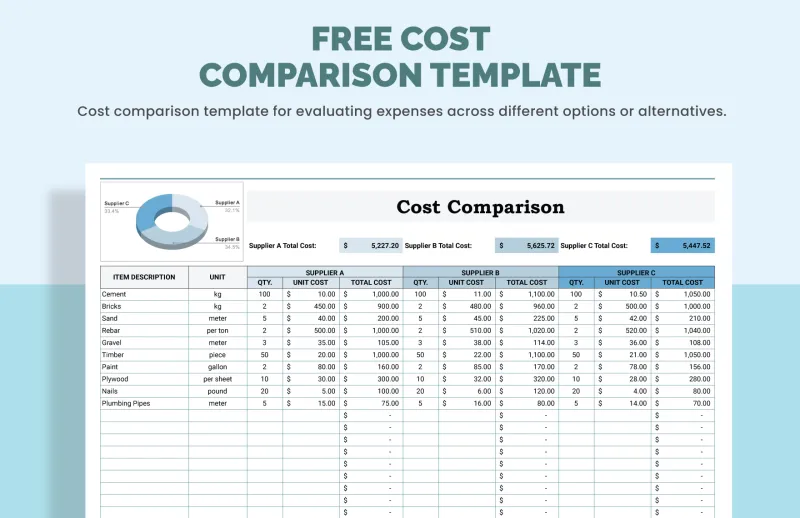
Photo: business financial planning office equipment cost comparison spreadsheet, via images.template.net
The Decision Most Businesses Make Without Enough Information
When a US business needs a new printer, the procurement conversation often focuses on a single number: the sticker price. A device that costs $400 outright seems straightforward to evaluate. One that requires a $150-per-month lease commitment feels more complex. And a managed service arrangement that bundles hardware, supplies, and maintenance into a single monthly fee can seem almost too abstract to compare.
The reality is that all three models carry substantially different financial profiles over a three-to-five-year horizon — and the model that appears least expensive at the point of acquisition frequently proves most costly over the life of the equipment. This guide is designed to bring those longer-term figures into sharper focus.
Model One: Outright Ownership
The appeal of purchasing printing equipment outright is intuitive. There are no ongoing contractual obligations, no interest charges, and no dependency on a third-party vendor's pricing decisions. For a small business with straightforward, low-volume printing needs, ownership can be the most economical path.
However, the total cost of ownership calculation must extend well beyond the purchase price. Consider the following components:
- Consumables. Toner, ink, and drum units represent a recurring expense that, for a moderately active office printer, can equal or exceed the device's purchase price within eighteen months.
- Maintenance and repairs. Without a service contract, repair costs are unpredictable. A single fuser replacement on a mid-range laser printer can run $200 to $400 in parts and labor.
- Technology obsolescence. The average productive lifespan of a business-grade printer is three to five years. After that point, driver compatibility issues, discontinued consumables, and declining reliability typically necessitate replacement.
- Capital expenditure classification. Under current IRS guidelines, equipment purchases may qualify for Section 179 expensing or bonus depreciation, which can meaningfully reduce the effective cost in the year of purchase — but this benefit requires active tax planning to capture.
Best suited for: Businesses with stable, predictable print volumes and in-house technical capacity to manage maintenance.
Model Two: Leasing Arrangements
Printer leasing has grown considerably as a preferred model among US small and mid-sized businesses, and the reasons are not difficult to understand. Leasing converts a capital expenditure into an operating expense, preserves cash flow, and typically includes provisions for technology refresh at the end of the lease term.
A standard equipment lease for a business-grade multifunction printer might run between $75 and $300 per month depending on device capability and lease duration. At first glance, this appears more expensive than ownership. Over a five-year period at $150 per month, a business would pay $9,000 for a device that might have cost $2,500 to purchase outright.
However, this comparison is incomplete without accounting for:
- Maintenance inclusions. Many lease agreements bundle preventive maintenance and repair coverage into the monthly fee, eliminating the unpredictable repair cost variable.
- Supply chain predictability. Leasing vendors often guarantee consumable availability for the duration of the contract, a meaningful consideration in an environment where supply chain disruptions have affected toner and component availability.
- Tax treatment. Lease payments are generally fully deductible as operating expenses in the year they are incurred, without the need for depreciation schedules or Section 179 elections. For businesses that prefer simplicity in their tax reporting, this is a genuine advantage.
- Upgrade flexibility. As printing technology evolves — particularly with the integration of cloud connectivity, security protocols, and remote management capabilities — leasing provides a structured pathway to newer equipment without the sunk cost friction of owned devices.
Best suited for: Growing businesses that anticipate evolving print needs, value cash flow predictability, and want to avoid the administrative burden of equipment ownership.
Model Three: Managed Print Services
The managed print services (MPS) model represents the most comprehensive approach to printer strategy, and it is gaining traction among US businesses that have recognized print infrastructure as a meaningful operational cost center.
Under an MPS arrangement, a service provider assumes responsibility for the entire print environment: hardware provisioning, supply replenishment, preventive maintenance, break-fix repair, and often remote monitoring. The business pays a single per-page or monthly flat rate, and the provider manages the complexity.
The financial case for MPS rests on several factors:
- Consumption-based pricing. Paying per page printed aligns costs directly with usage, eliminating the waste of maintaining underutilized equipment.
- Reduced internal IT burden. Businesses that have quantified the staff hours devoted to printer troubleshooting, supply ordering, and vendor coordination frequently find that those hours represent a significant hidden cost — one that MPS eliminates.
- Offshore provider advantages. Partnering with a technically capable international service provider for the support component of an MPS arrangement can substantially reduce the per-page cost while maintaining or improving service quality. Providers operating in markets with lower labor costs can offer monitoring, remote diagnostics, and coordination services at price points domestic vendors cannot match.
- Predictable budgeting. Finance teams consistently rank cost predictability as a primary driver of MPS adoption. Eliminating surprise repair bills and supply expenditure variance simplifies quarterly and annual budget planning.
Best suited for: Businesses with multiple devices, high print volumes, distributed locations, or limited internal IT capacity.
A Side-by-Side Comparison Framework
When evaluating these models, US businesses should build a five-year total cost model that incorporates the following variables:
| Cost Component | Ownership | Leasing | Managed Services |
|---|---|---|---|
| Hardware acquisition | High upfront | Spread monthly | Included |
| Consumables | Variable | Often separate | Included |
| Maintenance/repair | Unpredictable | Often included | Included |
| IT staff time | High | Moderate | Low |
| Technology refresh | At owner's expense | Built into lease cycle | Provider-managed |
| Tax treatment | Depreciation/Sec. 179 | Operating expense | Operating expense |
Making the Right Call for Your Organization
There is no universally correct answer to the lease-versus-buy question. The right model depends on print volume, cash flow priorities, internal technical capacity, and the degree to which predictability matters to the organization's financial planning.
What is clear, however, is that the decision deserves more analytical rigor than it typically receives. Businesses that evaluate all three models through a genuine total cost of ownership lens — rather than comparing sticker prices in isolation — consistently make more financially sound choices and experience fewer unpleasant surprises over the life of their equipment.
In 2024, with supply chain uncertainty, evolving security requirements, and the expanding availability of offshore support partnerships, the managed services model in particular warrants serious consideration from any US business that has not recently revisited its print strategy.